> For the complete documentation index, see [llms.txt](https://docs.edgetag.io/llms.txt). Markdown versions of documentation pages are available by appending `.md` to page URLs; this page is available as [Markdown](https://docs.edgetag.io/channels/universal-ads/onboarding.md).
# Onboarding
The Universal Ads team provides a conversion pixel snippet for each tracked page, where `tag_id` and `segment_key` change based on the URL of your site.
```html
```
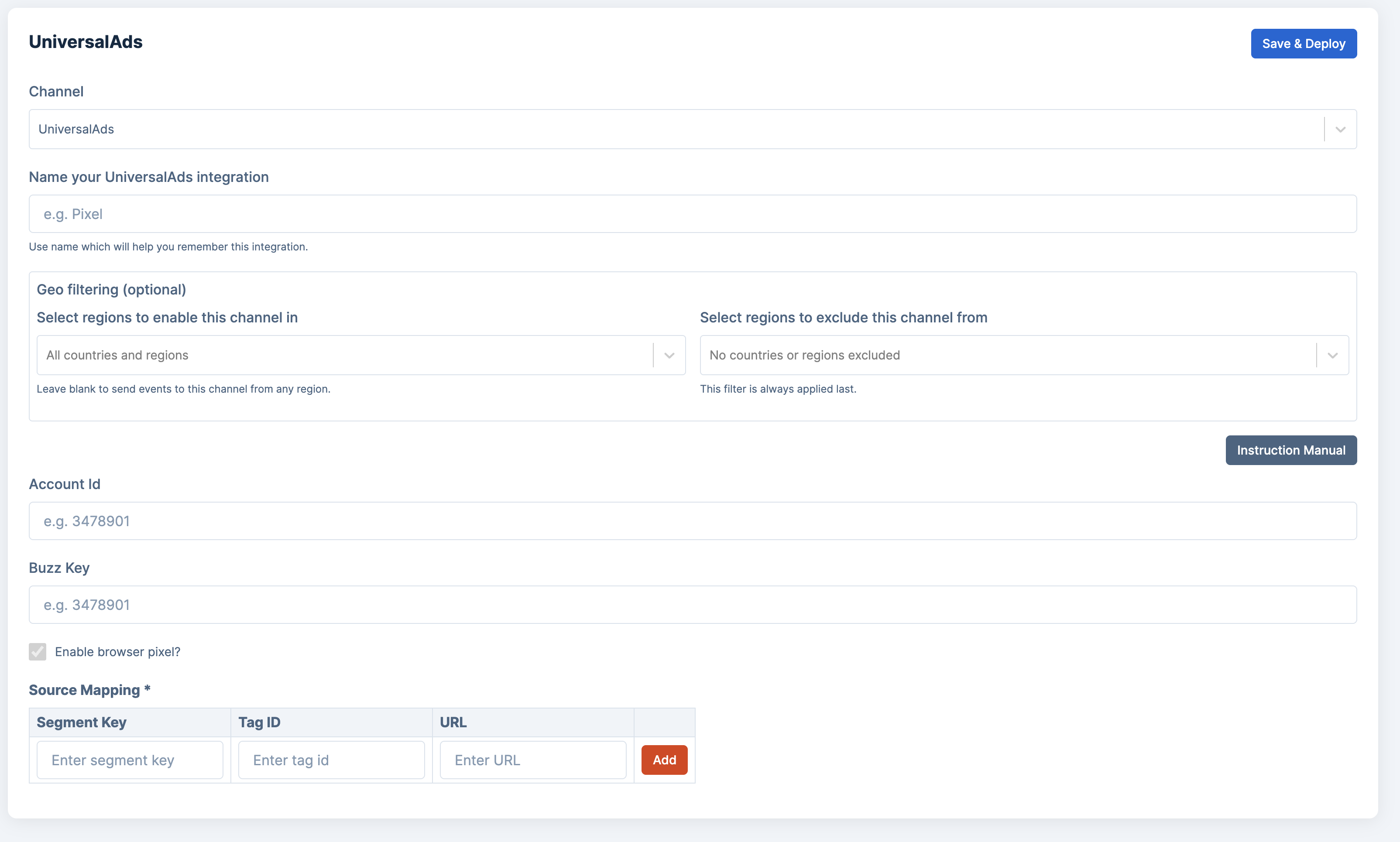
Onboarding requires filling out the provider form, and all the information can be found at the URL in the snippet above.
**Account Id** (`account_id`) - This is your Universal Ads account ID
**Buzz Key** (`buzz_key`) - This is the buzz key provided by Universal Ads
**Source Mapping** (`tag_id`, `segment_key`)- This is used to map a Tag ID and Segment Key pair to a specific URL of your site
**Example Source Mapping:**
Segment Key
Tag ID
URL
Description
ua-1331
1111
https://edgetag.io
Landing page
ua-1332
2222
https://edgetag.io/thank-you
Thank you page
ua-1333
3333
https://edgetag.io/products/*
Product pages
{% hint style="info" %}
URLs are matched on origin + path only — query strings, hashes and trailing slashes are ignored. Matching is case-insensitive. A \* wildcard matches exactly one path segment, so \* matches but not .
{% endhint %}
### Add Channel
To add a channel, enter the channel's name. We recommend choosing a name that clearly describes the channel you are adding. This will assist with debugging if any issues arise.
At least one mapping with a `Segment Key`, `Tag ID` and `URL` is required. Each URL can only be added once. If a page URL does not match any mapping, no pixel is fired for that page.
Click **Save & Deploy**
Congratulations :tada:, the basic setup is now complete.
Let's proceed to the next section to explore additional configuration options.
---
# Agent Instructions
This documentation is published with GitBook. GitBook is the documentation platform designed so that both humans and AI agents can read, navigate, and reason over technical content effectively. Learn more at gitbook.com.
## Querying This Documentation
If you need additional information that is not directly available in this page, you can query the documentation dynamically by asking a question.
Perform an HTTP GET request on the current page URL with the `ask` query parameter, and the optional `goal` query parameter:
```
GET https://docs.edgetag.io/channels/universal-ads/onboarding.md?ask=&goal=
```
`ask` is the immediate question: it should be specific, self-contained, and written in natural language.
`goal` is optional and describes the broader end goal you are ultimately trying to accomplish on behalf of the user. GitBook uses it to tailor the answer towards what is most useful for that goal.
The response will contain a direct answer to the question and relevant excerpts and sources from the documentation.
Use this mechanism when the answer is not explicitly present in the current page, you need clarification or additional context, or you want to retrieve related documentation sections.