> For the complete documentation index, see [llms.txt](https://docs.edgetag.io/llms.txt). Markdown versions of documentation pages are available by appending `.md` to page URLs; this page is available as [Markdown](https://docs.edgetag.io/how-to/verify-event-transforms.md).
# Verify Event Transforms
### What are keyword conversions?
Keyword conversions is a feature where you can **map keywords** to custom conversions. In a Purchase event, if we see any mapped keyword present in the fields of the event payload (see below) after we transform them, we fire the mapped custom conversion. E.g. if keyword "shirt" is present in `contents.title`, we fire the mapped custom conversion of that keyword.
### Transform payload fields
When looking for keywords, we are considering the following fields in the payload:
* `contents.title`
* `contents.brand`
* `contents.description`
* `keywords`
When transforming, we will remove punctuations, replace word split characters with spaces, changes text to lower case etc.
**Examples**
"White\_shirt" would be "whiteshirt"
"Red\_Cap.Embroidered" would be "redcap embroidered"
### How to create a keyword conversion mapping?
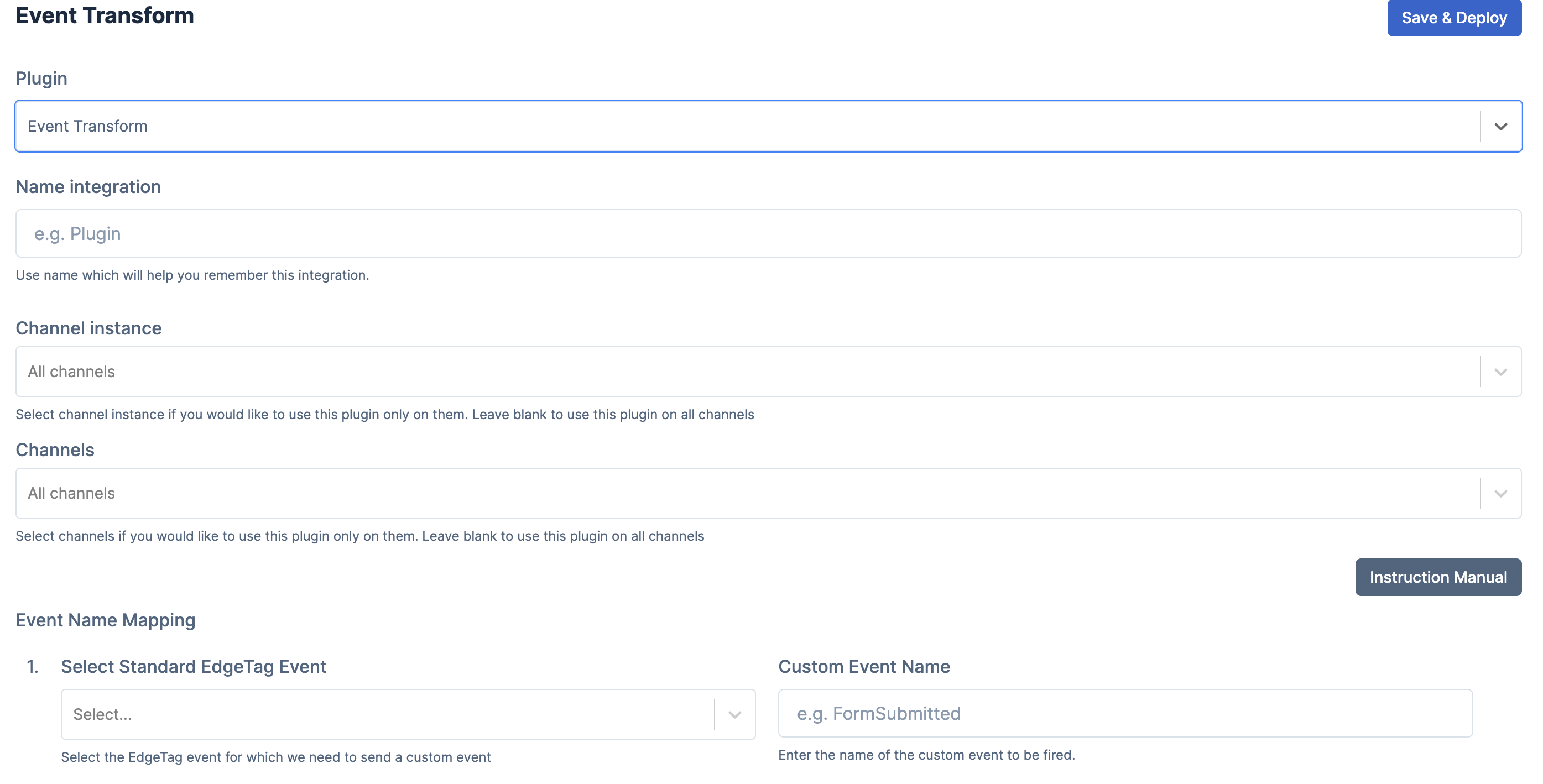
Once you know the keyword that can be used, please go to the plugins page, select the plugin that you want to add keyword conversion mapping, add keyword in the left dropdown and the custom conversion name in the right dropdown and save the form.
For understanding how you can use this feature as a marketer, Please refer to our guide here.
{% embed url="" %}
---
# Agent Instructions
This documentation is published with GitBook. GitBook is the documentation platform designed so that both humans and AI agents can read, navigate, and reason over technical content effectively. Learn more at gitbook.com.
## Querying This Documentation
If you need additional information that is not directly available in this page, you can query the documentation dynamically by asking a question.
Perform an HTTP GET request on the current page URL with the `ask` query parameter, and the optional `goal` query parameter:
```
GET https://docs.edgetag.io/how-to/verify-event-transforms.md?ask=&goal=
```
`ask` is the immediate question: it should be specific, self-contained, and written in natural language.
`goal` is optional and describes the broader end goal you are ultimately trying to accomplish on behalf of the user. GitBook uses it to tailor the answer towards what is most useful for that goal.
The response will contain a direct answer to the question and relevant excerpts and sources from the documentation.
Use this mechanism when the answer is not explicitly present in the current page, you need clarification or additional context, or you want to retrieve related documentation sections.