> For the complete documentation index, see [llms.txt](https://docs.edgetag.io/llms.txt). Markdown versions of documentation pages are available by appending `.md` to page URLs; this page is available as [Markdown](https://docs.edgetag.io/onboarding/e-commerce/custom-landing-page/fermat.md).
# FERMÀT
Setting up EdgeTag on your FERMÀT sites is designed to be simple and requires no coding. This streamlined integration enables you to track complete user journeys and collect first-party data securely across your FERMÀT funnels.
This guide walks you through setting up standard event tracking on your FERMÀT sites.
### Prerequisites
Before you begin, ensure you have:
**Blotout EdgeTag Domain Registration** – Your registered domain or subdomain details from your Blotout EdgeTag Dashboard.
{% hint style="info" %}
If you **do not** have the registration details - Please follow our [guide to Get started on EdgeTag ](/overview/getting-started.md)
{% endhint %}
**FERMÀT Dashboard Access** – Login credentials and access to your FERMÀT account
### Setup process
FERMÀT has built a seamless integration with EdgeTag, eliminating the need for manual code implementation and providing a streamlined, dashboard-based setup experience.
#### Step 1: Gather your EdgeTag details
* Log in to your **Blotout EdgeTag Dashboard**
* Navigate to **Your Sites** on the dashboard
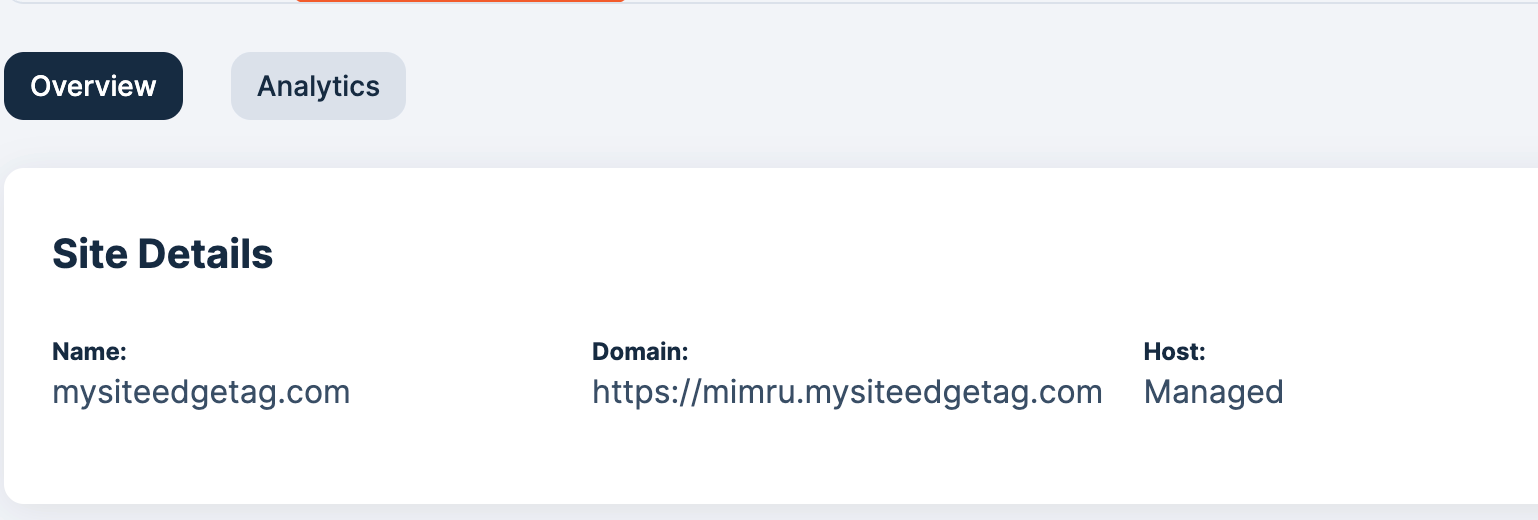
* Copy your registered domain/subdomain URL
* Keep this information ready for the next step
#### Step 2: Access FERMÀT integration settings
* Log in to your FERMÀT Dashboard
* Navigate to your funnel settings or integration section
* Look for the EdgeTag or tracking integration options
#### Step 3: Follow FERMÀT's setup instructions
FERMÀT provides comprehensive documentation and video tutorials for EdgeTag integration:
[Access FERMÀT's EdgeTag Setup Guide](https://help.fermatcommerce.com/en/articles/11069554-connecting-fermat-and-blotout)
{% hint style="info" %}
Note: The FERMÀT team maintains these resources and includes step-by-step instructions specific to their platform.
{% endhint %}
---
# Agent Instructions
This documentation is published with GitBook. GitBook is the documentation platform designed so that both humans and AI agents can read, navigate, and reason over technical content effectively. Learn more at gitbook.com.
## Querying This Documentation
If you need additional information that is not directly available in this page, you can query the documentation dynamically by asking a question.
Perform an HTTP GET request on the current page URL with the `ask` query parameter, and the optional `goal` query parameter:
```
GET https://docs.edgetag.io/onboarding/e-commerce/custom-landing-page/fermat.md?ask=&goal=
```
`ask` is the immediate question: it should be specific, self-contained, and written in natural language.
`goal` is optional and describes the broader end goal you are ultimately trying to accomplish on behalf of the user. GitBook uses it to tailor the answer towards what is most useful for that goal.
The response will contain a direct answer to the question and relevant excerpts and sources from the documentation.
Use this mechanism when the answer is not explicitly present in the current page, you need clarification or additional context, or you want to retrieve related documentation sections.