> For the complete documentation index, see [llms.txt](https://docs.edgetag.io/llms.txt). Markdown versions of documentation pages are available by appending `.md` to page URLs; this page is available as [Markdown](https://docs.edgetag.io/channels/claritas/onboarding.md).
# Onboarding
Claritas channels provide a straightforward setup process, utilizing Pixel ID and event mappings to connect your marketing data seamlessly. This connection enables your site to stream conversion events, providing detailed consumer segmentation and targeting insights. Let's walk through the steps.
### Add Channel
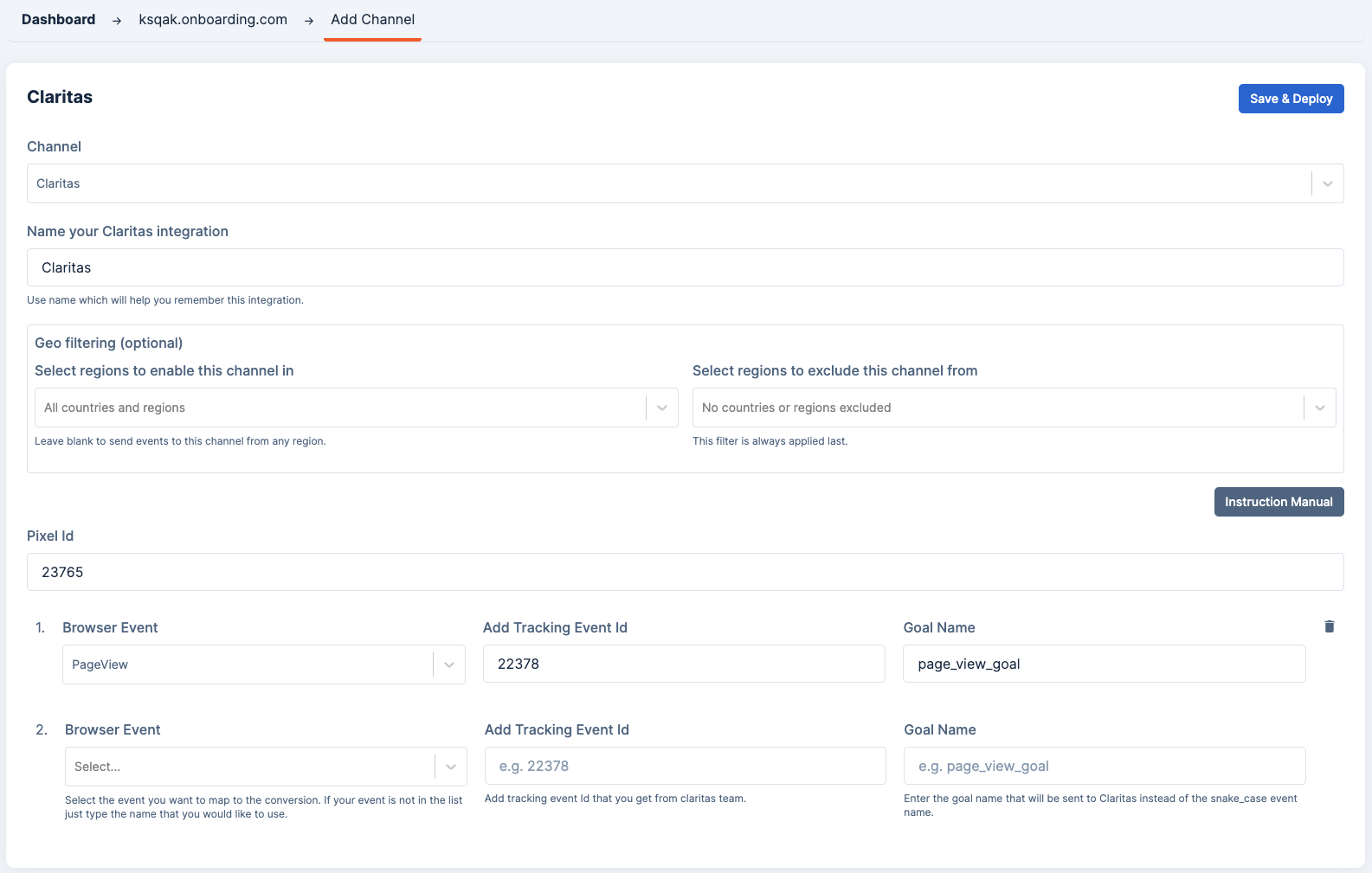
To add a channel, begin by entering the channel's name. We recommend choosing a name that clearly describes the channel you are adding. This will assist with debugging if any issues arise. Once you have entered the name, you'll need to configure your Pixel ID and event mappings.
### Get Configuration Details
All configuration fields are provided by your Claritas representative, who will assist you in completing this integration. Reach out to them directly to obtain the required information for your setup.
### Pixel ID
Your Claritas representative will provide you with a **Pixel ID** that identifies your specific tracking pixel within the Claritas platform. This ID is unique to your account and determines where your event data should be sent.
Copy the Pixel ID provided by your Claritas team and enter it into EdgeTag's **Pixel ID** field.
### Event Mapping
The **Event Mapping** configuration allows you to map EdgeTag events to corresponding events in your Claritas account. This mapping ensures that events are properly categorized and processed within the Claritas platform.
---
# Agent Instructions
This documentation is published with GitBook. GitBook is the documentation platform designed so that both humans and AI agents can read, navigate, and reason over technical content effectively. Learn more at gitbook.com.
## Querying This Documentation
If you need additional information that is not directly available in this page, you can query the documentation dynamically by asking a question.
Perform an HTTP GET request on the current page URL with the `ask` query parameter, and the optional `goal` query parameter:
```
GET https://docs.edgetag.io/channels/claritas/onboarding.md?ask=&goal=
```
`ask` is the immediate question: it should be specific, self-contained, and written in natural language.
`goal` is optional and describes the broader end goal you are ultimately trying to accomplish on behalf of the user. GitBook uses it to tailor the answer towards what is most useful for that goal.
The response will contain a direct answer to the question and relevant excerpts and sources from the documentation.
Use this mechanism when the answer is not explicitly present in the current page, you need clarification or additional context, or you want to retrieve related documentation sections.