> For the complete documentation index, see [llms.txt](https://docs.edgetag.io/llms.txt). Markdown versions of documentation pages are available by appending `.md` to page URLs; this page is available as [Markdown](https://docs.edgetag.io/channels/event-sink/configuration.md).
# Configuration
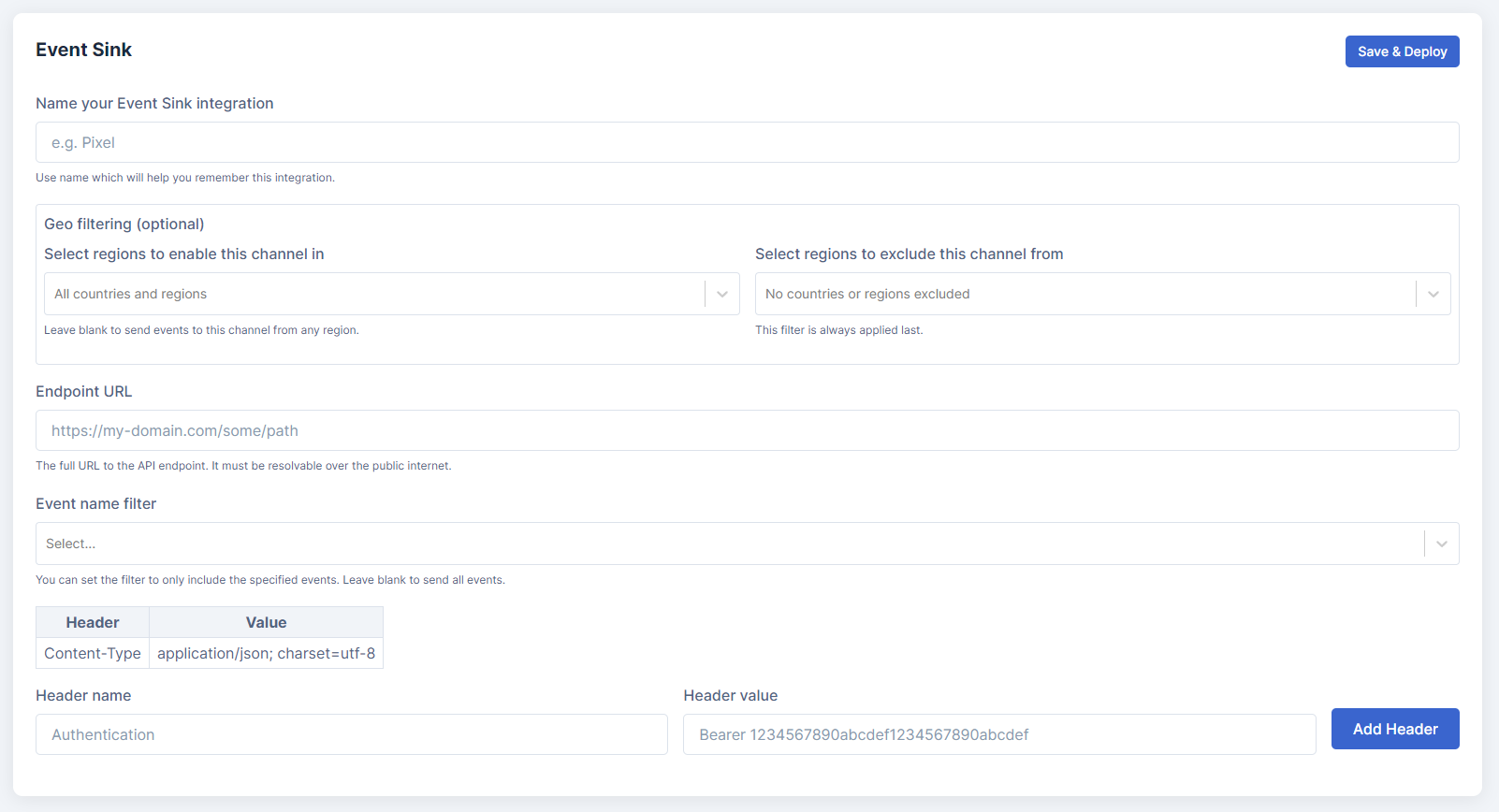
To set up Event Sink, make sure to have your full publicly accessible endpoint ready (e.g. `https://my-domain.com/event`).
### Endpoint URL
Use this field to specify the full URL of the endpoint you would like to send EdgeTag event payloads to.
The endpoint itself should receive POST requests with a JSON payload and respond with a `200 OK` response. The response body will not be used, but the response code will be used to determine whether the event was delivered successfully or not.
### Event name filter
You can choose to limit events being sent by their event name. You can select or specify any number of event names you would like us to send to the endpoint, or you can leave this field blank to allow forwarding all events.
### Request headers
You can add additional headers that will be sent along with the POST request to your endpoint. A typical example is adding an `Authentication` header with a token that authenticates the request according to your endpoint's rules.
The `Content-Type` header will always be sent along with the request since the payload itself will always be a valid JSON object.
Example:
| Header | Value |
| ---------------- | ----------------------------------------- |
| `Authentication` | `Bearer 1234567890abcdef1234567890abcdef` |
{% hint style="warning" %}
To prevent random traffic from generating invalid requests or sending fraudulent events, we recommend setting up an authentication mechanism, such as the token example above, to protect your system from malicious actors.
{% endhint %}
---
# Agent Instructions
This documentation is published with GitBook. GitBook is the documentation platform designed so that both humans and AI agents can read, navigate, and reason over technical content effectively. Learn more at gitbook.com.
## Querying This Documentation
If you need additional information that is not directly available in this page, you can query the documentation by asking a question.
Perform an HTTP GET request on the following URL with the `ask` and `goal` query parameters:
```
GET https://docs.edgetag.io/channels/event-sink/configuration.md?ask=&goal=
```
`ask` is the immediate question: it should be specific, self-contained, and written in natural language.
`goal` is what the user is ultimately trying to achieve, the reason they need the answer. Sharing it helps GitBook give you a better, more relevant answer. A goal is most helpful when it describes the outcome the user wants rather than restating the question. For example, with `ask=how do I create an API token`, a goal like `automate deployments from our CI pipeline` lets GitBook tailor the answer to that use case.
The response will contain a direct answer to the question and relevant excerpts and sources from the documentation.
Use this mechanism when the answer is not explicitly present in the current page, you need clarification or additional context, or you want to retrieve related documentation sections.